Retail consolidation and managed transportation get discussed as if they are competing strategies. They are not. Consolidation is a tactic for combining freight into fewer, fuller truckloads. Managed transportation is the operating model that orchestrates the entire network. Retail shippers who pick one over the other usually end up underserved on cost or compliance. Run together, the two produce savings and service improvements that neither delivers alone.
What Is Retail Consolidation?
Retail consolidation is the practice of combining multiple suppliers' shipments into a single truckload destined for a retailer's distribution center. It typically takes three forms:
- Pooling - aggregating shipments at a common origin point
- Multi-stop truckload - picking up at several suppliers on one truck
- LTL to truckload conversion - consolidating what would have been many small shipments into one
The benefits are straightforward. Fewer trucks means lower linehaul cost per unit. Fewer touches means less damage. Tighter delivery windows means fewer OTIF chargebacks. And retailers prefer consolidated deliveries because they reduce congestion at receiving docks. ODW's retail consolidation program delivers 20 to 30 percent savings for shippers into Walmart, Target, and similar big-box networks.
What Is Managed Transportation?
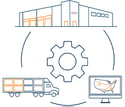
Managed transportation is the orchestration layer that sits across the entire transportation network. It covers carrier procurement, load planning, appointment scheduling, real-time visibility, exception management, and continuous performance measurement. Think of it as the operating system that runs all the freight decisions inside a business. Our guide to enterprise managed transportation covers the full operating model.
A managed transportation engagement typically combines a transportation management system, a carrier network, planners and analysts, and reporting that ties freight activity back to cost and service KPIs. ODW's managed transportation solution brings these pieces together under TM Link, our connected load, carrier, and analytics platform.
Key Differences Between Consolidation and Managed Transportation
|
Dimension
|
Retail Consolidation
|
Managed Transportation
|
|
Scope
|
Specific to retail-bound freight
|
Entire transportation network
|
|
Function
|
Combines shipments into fuller loads
|
Plans, executes, and optimizes all freight
|
|
Technology
|
Pooling software, consolidation engine
|
TMS, visibility platform, analytics
|
|
Ownership
|
Typically managed by a 3PL or specialist
|
Managed by a 3PL, an in-house team, or a hybrid
|
|
Primary outcome
|
Lower retail freight cost and improved compliance
|
Network-wide cost control, service, and visibility
|
Consolidation answers the question: how do we get this freight to the retailer in the cheapest, most compliant way? Managed transportation answers: how do we run all of our transportation?
Why Retail Shippers Need Both (Not Either/Or)
Treating consolidation and managed transportation as alternatives leaves savings on the table. Consolidation is a tactic. Managed transportation is the system that applies that tactic consistently, across every lane, every week. Without orchestration, consolidation opportunities get missed. Without consolidation, orchestrated networks pay too much for LTL shipments that could have been combined.
Run together, consolidation becomes a repeatable lever that managed transportation pulls whenever the load pattern warrants it. The savings compound because the same carrier network, visibility layer, and analytics platform support both.
Use Case: Walmart & Big-Box Retail Networks
Walmart’s OTIF program illustrates why the combination matters. The program penalizes suppliers for shipments that miss the delivery window or arrive short on units. Single-supplier LTL freight into Walmart DCs is especially exposed, because each additional handoff is another chance to miss the window.
Consolidation converts those LTL shipments into a single truckload with a planned delivery appointment. Managed transportation assigns a vetted carrier to that truckload, tracks it in real time, and intervenes if transit runs long. The result is lower freight cost per unit and higher OTIF compliance on the same shipments. Our guide to managed transportation for Walmart shippers covers the OTIF side in more detail.
How Combining Both Drives Cost Savings and Service Improvements
Shippers who run consolidation inside a managed transportation framework commonly see three outcomes:
- Reduced LTL spend. Load-level conversion from LTL to consolidated truckload typically removes 20 to 30 percent of freight cost for retail lanes (ODW operational data).
- Improved fill rates. Appointment scheduling plus consolidation means more orders land in-full on the first attempt, reducing partial shipments and re-work.
- Fewer chargebacks. On-time performance rises because fewer shipments means fewer chances to miss a window, and the ones that do ship are tracked and managed actively.
The savings that come from combined consolidation and managed transportation are the reason Sabrosura Foods was able to reduce freight costs by 28% through ODW's freight optimization solution (read the case study).
How to Implement a Combined Strategy
Retail shippers exploring a combined consolidation and managed transportation approach typically move through four steps:
- Network analysis. Map current freight patterns by retailer, DC, and lane. Identify where LTL frequency creates consolidation opportunity.
- Consolidation design. Choose the consolidation mechanics that fit the pattern. Pool points, multi-stop, or hybrid.
- Orchestration layer. Implement the managed transportation capability that will run the consolidated network. TMS, carrier governance, visibility, and KPIs.
- KPI tracking. Set targets for freight cost per unit, OTIF, fill rate, and trailer utilization. Measure weekly. Adjust carriers and routing as the data dictates.
ODW runs this sequence with shippers on a standard cadence, beginning with a network review and producing a consolidation plus managed transportation design that ties to specific OTIF and cost targets. See how enterprise shippers control freight costs for more on the structured approach. For how this plays out as volume grows, see scaling transportation for big box retailers.
Learn How ODW Combines Consolidation + Managed Transportation
Retail shippers who want both tactics working together do not have to build the capability in-house. ODW pairs a purpose-built retail consolidation program with a full managed transportation platform in a single engagement. Start the conversation today. Request a consultation.