

.png?width=105&height=85&name=ODW_Icon_Food_Bev%20(1).png)
-1.png?width=151&height=85&name=ODW_Icon_ConsumerGoods%20(1)-1.png)
.png?width=139&height=85&name=ODW_Icon_Industrial%20(1).png)





.png?width=96&height=100&name=ODW_Icon_CaseStudy-v2%20(1).png)
.png?width=153&height=100&name=ODW_Icon_Blog3%20(1).png)
.png?width=100&height=100&name=ODW_Icon_NewsPress3%20(1).png)
.png?width=162&height=100&name=ODW_Icon_Video3%20(1).png)
Most 3PLs talk about technology. The practical question is whether their systems talk to each other. A warehouse management system that doesn't feed into transportation decisions, a labor management platform that can't access robotics output, or an inventory robot that scans but doesn't sync with a digital twin produces isolated data, not supply chain intelligence. ODW's approach to integrated logistics technology reflects what modern connected operations actually require: systems that share data automatically, so decisions are made against current information rather than last week's reports.
What "Integrated" Actually Means in Practice
Integrated logistics means data flows between systems without manual translation. In practice: a WMS that informs transportation consolidation decisions the moment inventory is received and verified; a labor management platform drawing pick-rate and process data from both WMS and robotics in the same dashboard; an autonomous robot that scans 20,000+ storage locations per mission and feeds results into a digital twin accessible to the full operations team.
When systems are siloed, the costs are direct and compounding. Manual reconciliation consumes hours that multiply across facilities. Inventory discrepancies lead to retailer chargebacks. Transportation planning without current warehouse data produces inefficient loads. OTIF failures get logged after the fact instead of prevented in advance.
A connected 3PL technology stack closes each of those gaps at the data layer, not just the process layer. That distinction matters because process-level fixes require ongoing human coordination; data-layer fixes produce results automatically.
The gap between providers who have built this kind of integration and those who have not is widening. According to the Council of Supply Chain Management Professionals, data visibility consistently ranks among the top operational priorities for supply chain executives, and the expectation from shippers that their 3PL will provide it, not just describe it, has grown significantly (CSCMP State of Logistics, 2024).
ODW's Technology Stack: What's Live and What It Does
ODW's technology investments are production deployments. Each system below is operational today and produces measurable results across client operations.
TM-Link (Transportation Management System)
ODW's TM-Link is a purpose-built TMS designed for end-to-end supply chain visibility, freight consolidation, and carrier management. It connects warehousing data to transportation execution so that load planning and carrier selection run against real inventory status, not estimates. For brands shipping to major retail partners with strict OTIF requirements, TM-Link's visibility layer surfaces delivery risk before a window closes rather than after a chargeback posts.
TM-Link's consolidation logic is what enables Sabrosura Foods to achieve a 28% freight cost reduction after moving to ODW's integrated model. When the TMS can see inbound inventory in real time, it can build fuller, more efficient outbound loads. That's not possible when the WMS and TMS are reporting to different systems on different schedules.
Boston Dynamics' Stretch Robot
ODW has deployed Boston Dynamics' Stretch robot to accelerate trailer unloading, reducing inbound processing time by 50%. Manual trailer unloading creates throughput variability and physical strain on associates. Stretch handles repetitive heavy lifting at consistent throughput, producing faster inbound cycle times and more predictable labor allocation downstream. When inbound speed is a bottleneck on fulfillment, this is the constraint Stretch removes.
Takt (Cloud-Based Labor Management System, deployed November 2024)
Takt unifies labor logs, WMS data, automation output, and robotics performance into a single dashboard across multiple distribution centers. Supervisors see real-time productivity data rather than end-of-shift summaries, which means coaching and workflow adjustment can happen during the shift (when it changes outcomes) instead of in the next morning's review meeting.
Results from ODW's Takt deployment: a 29% increase in workforce productivity and a 39% improvement in employee retention. Both numbers matter. Productivity gains improve throughput directly. Retention gains matter because experienced associates make fewer errors, process freight faster, and require less supervisory overhead.
As Adam Schlaudeckler, Director of Engineering at ODW Logistics, notes: "This modern tool improves operational costs, provides better visibility into process and people performance, and identifies areas of waste to drive continuous improvement initiatives."
Takt's architecture matters for integration: it pulls data from the WMS, from robotics sensors, and from time-and-motion tracking into a single view. That means the labor data isn't siloed from the operational data. The supervisor's dashboard is the same dashboard that surfaces a pick-rate slowdown, connects it to a storage-location issue flagged by DexoryView, and routes the fix to the right team. See our Takt partnership overview for more detail on the deployment.
Dexory / DexoryView (Autonomous Inventory Scanning + Digital Twin, deployed December 2025)
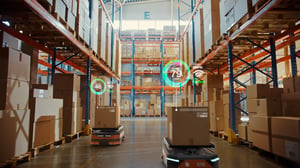
An autonomous mobile robot navigates ODW's Columbus, OH facility without interrupting floor operations, scanning 20,000+ storage locations per mission. Results feed into DexoryView, a real-time digital twin that gives the operations team a current visual representation of pallet positions, inventory levels, and discrepancies, accessible from any device, updated after every scan cycle.
Scans run multiple times per week. Inventory discrepancies that previously surfaced during manual cycle counts or (worse) during a retailer audit, now surface automatically between shipments. CHEP and PECO pallet auditing for retail clients runs as part of the scan routine, reducing chargeback exposure before billing disputes occur.
Kayla Watson, Sr. Inventory Manager at ODW Logistics: "DexoryView has transformed how we manage inventory and identify process issues. The ability to complete autonomous scans, capture detailed data, and act on insights in real time has allowed our teams to work more efficiently, with fewer discrepancies and faster problem resolution."
Zebra Symmetry Fulfillment (AMR-Enabled Pick Optimization, deployed October 2025)
Zebra's autonomous mobile robot platform transitions ODW's e-commerce fulfillment operations from a pick-to-tote to a pick-to-shipper model. Rather than picking into a tote that moves to a packing station, associates work directly into shipping containers with AMRs managing transport between pick locations. Zebra's directed workflow software sequences picks to eliminate backtracking. Detachable baker's rack carts allow associates to complete multi-SKU picks without waiting for conveyance to return.
ODW's anticipated outcome from this deployment: a 42% improvement in pick rates. That's not a pilot projection. It reflects the documented throughput data from Zebra Symmetry deployments in comparable fulfillment environments.
For e-commerce clients, this means more orders fulfilled per shift on the same square footage, with labor focused on value-added picking rather than tote management and station wait times.
Merged TMS + Contract Logistics
ODW's transportation management and contract logistics operations have operated under unified ownership since January 2024. The integration is structural, not just technical: freight consolidation decisions, warehousing throughput data, and transportation execution share the same operational leadership and the same data infrastructure.
The 565,000 sq ft retail consolidation center, operational since October 2023, is the physical manifestation of this model. When warehouse operations and transportation management share a P&L, they share an incentive to reduce the cost of coordination between them.
How Integration Supports Each Business Unit
The value of connected systems is not uniform across service lines. Here is what it produces differently across ODW's four primary business units.
Retail Consolidation: In retail consolidation, inefficiencies compound into retailer penalties. A pallet audit error becomes a CHEP chargeback. A missed delivery window becomes an OTIF violation with a dollar figure attached. When DexoryView's inventory data is connected to TM-Link's load planning, those risks surface before violations occur. Freight consolidation decisions are made against live warehouse data, not the prior day's report.
E-Commerce Fulfillment: Pick-to-shipper workflows only function when the WMS and robotics layer share current order data. If the AMR and the WMS operate independently, pick sequencing requires manual coordination. ODW's e-commerce fulfillment operations run on connected data: Zebra's AMR platform receives directed workflow instructions from the WMS in real time. That integration is what makes the 42% pick-rate improvement achievable at scale.
Managed Transportation: A TMS that runs independently from warehousing leaves freight consolidation opportunities on the table. When a trailer ships at partial capacity because warehouse throughput data wasn't available at load planning time, that gap shows up in freight cost but rarely on any single report. ODW's managed transportation service operates within the same data infrastructure as contract logistics, which is why the Sabrosura Foods freight cost reduction was 28%, not a marginal improvement.
Contract Logistics: Multi-facility contract operations require consistent benchmarks across sites. Labor productivity at one DC should be visible to operations leadership at every facility in the network. Takt's deployment across multiple ODW distribution centers provides that cross-site view: the same dashboard, the same performance definitions, the same ability to identify process variance regardless of which facility it appears in.
Why Connected Data Matters More Than Individual Tools
Any 3PL can license a WMS. Any provider can add an AMR to a fulfillment floor. The differentiator is whether those tools produce actionable intelligence or isolated data points. ODW's stack produces the former because the systems are connected by design.
When Takt's labor data, DexoryView's inventory scans, Zebra's pick metrics, and TM-Link's freight data share common reporting infrastructure, patterns become visible that siloed systems would miss. A slower pick rate on a specific shift, traced to a storage-location cluster that DexoryView flagged for reorganization, is a finding that requires both systems to surface. Neither produces it alone.
That's what integrated logistics technology means in an operating context: not a list of vendors, but a stack where the data from each system informs the others.
Consider what this looks like at the operational level during peak season. A retailer moves a delivery window 48 hours earlier. In a siloed environment, the warehouse learns about it separately from the transportation team, adjustments happen manually, and the risk of a compliance miss rises. In a connected environment, TM-Link's updated delivery window triggers a review of warehouse throughput from Takt's dashboard, DexoryView confirms inventory is in the right locations, and the outbound plan updates automatically. The same 48-hour window change produces a different operational outcome depending entirely on whether the systems are connected.
See our guide to supply chain innovation for how ODW approaches the design of connected operations.
What to Look for When Evaluating a 3PL's Technology Capabilities
When assessing a potential 3PL partner's technology stack, these questions distinguish providers with connected operations from those with a collection of tools:
- Does the provider's WMS connect directly to their TMS, or is there a manual handoff step between warehouse and transportation?
- Can labor performance data be viewed in real time, or only in end-of-day batch reports?
- Is robotics deployment OEM-agnostic, or is the provider tied to a single hardware vendor?
- How is inventory reconciliation handled: automated scanning at regular intervals, or periodic manual cycle counts?
- Does the provider have published, named proof points from live technology deployments, with specific metrics, named partners, and verifiable outcomes, or only general capability descriptions?
- Can the provider's technology stack integrate with your existing ERP and order management systems?
- What does the provider's technology roadmap look like, and how quickly have they deployed new systems over the past 24 months?
ODW has deployed six major technology systems in the past 14 months: Takt, Dexory/DexoryView, Zebra Symmetry Fulfillment, Boston Dynamics Stretch, Passport international parcel (covering 180+ countries), and a merged TMS platform. Each deployment is live and documented. For brands evaluating 3PL partners on technology, that track record is the clearest available signal.
For more on how ODW's warehouse automation and technology approach supports your operation, or to start a conversation about your specific supply chain requirements, request a quote.

ODW Logistics
Since 1971, we’ve been providing warehousing, distribution, and transportation solutions for hundreds of brands. We operate as an extension of your business to control costs throughout your supply chain that deliver you a competitive advantage over your competition.RECENT POSTS
The Most Common Way a Managed Transportation Pilot Fails A mid-market VP of Supply Chain walks into a meeting with a man...
Sep. 25, 2026 11:51 AM
What Is a Retail Consolidation Program? A retail consolidation program combines freight from multiple CPG shippers headi...
Sep. 25, 2026 11:29 AM
As e-commerce order volumes continue to grow, fulfillment operations face increasing pressure to maintain speed, accurac...
Sep. 14, 2026 15:42 PM
.png)