


.png?width=105&height=85&name=ODW_Icon_Food_Bev%20(1).png)
-1.png?width=151&height=85&name=ODW_Icon_ConsumerGoods%20(1)-1.png)
.png?width=139&height=85&name=ODW_Icon_Industrial%20(1).png)





.png?width=96&height=100&name=ODW_Icon_CaseStudy-v2%20(1).png)
.png?width=153&height=100&name=ODW_Icon_Blog3%20(1).png)
.png?width=100&height=100&name=ODW_Icon_NewsPress3%20(1).png)
.png?width=162&height=100&name=ODW_Icon_Video3%20(1).png)
What Is a Retail Consolidation Program?
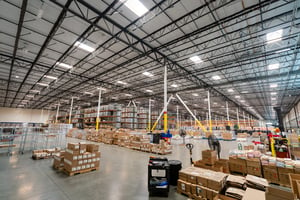
A retail consolidation program combines freight from multiple CPG shippers heading to the same retail distribution centers into shared, fuller truckloads instead of each shipper sending partial loads separately. Rather than one supplier's truck leaving 40% empty, a consolidation provider fills that trailer with freight from several shippers going to the same Walmart, Target, or grocery DC network, then delivers it as a single appointment. For CPG brands, this usually means lower freight cost, better on-time performance, and fewer retailer fines, without giving up control over inventory or customer relationships.
Key Benefits of a CPG Retail Consolidation Program
A CPG retail consolidation program can help brands:
- Reduce freight costs by combining smaller LTL shipments into more efficient truckload deliveries
- Improve OTIF performance through retailer-aligned schedules, optimized routing, and appointment management
- Reduce chargebacks and compliance risk by better managing retailer routing guides, labeling, documentation, and delivery requirements
- Gain better shipment visibility with milestone tracking and proactive updates throughout the delivery process
- Simplify retail distribution by managing shipments to multiple major retailers through one experienced consolidation partner
- Reduce unnecessary truck miles and emissions by moving more freight on fewer, fuller trailers
Retail Consolidation vs. LTL Shipping
Retail consolidation and LTL shipping both move partial truckloads, but they solve the problem differently. LTL carriers combine freight from many shippers going to many different destinations, with multiple stops and transfers between origin and delivery. Retail consolidation programs combine freight specifically bound for the same retailer's network, run tighter appointment scheduling, and typically produce fewer touches per shipment. That difference shows up directly in performance, for example, CPG shippers using ODW's retail consolidation program have seen 20 to 30% cost reductions compared to traditional LTL shipping, with average trailer utilization around 87%.
How Retail Consolidation Improves OTIF Performance
On-time, in-full performance improves under consolidation because shipments run on a fixed, predictable schedule into a specific retail network instead of competing for space on a general LTL network with variable transit times. Retailers have gotten stricter about this, not looser. Walmart's OTIF standard moved to 90% on-time and 95% in-full starting in February 2024, and suppliers were still paying roughly 0.16% of cost of goods sold in fines even under that adjusted threshold. Consolidation programs are built around that specific standard, with appointment scheduling and load planning designed to hit the delivery window consistently rather than treating it as an occasional target.
How Retail Consolidation Helps CPG Suppliers Avoid Retailer Fines
Most retailer fines trace back to a small set of causes: missed delivery appointments, incomplete case counts, or shipment configuration errors that trigger automatic deductions at the retailer's dock. Consolidation programs reduce all three by controlling the shipment from a single point, with one provider managing appointment scheduling, load configuration, and delivery timing instead of coordinating across multiple carriers. CPG suppliers using ODW's program have seen retailer fines drop 80 to 90%, largely because the appointment and configuration failures that trigger those fines get caught before the truck leaves the dock, not after.
What to Look for in a Retail Consolidation Partner
Not every consolidation program is built the same way. CPG shippers evaluating a partner should look at a few specifics rather than taking cost claims at face value: how many retailers the provider already serves in consolidation (a provider is not truly consolidating if it's building routes just for one shipper), trailer utilization rates the provider can actually show, warehouse locations relative to the retailer distribution centers being served, and how appointment scheduling and exception handling work when a load misses its window. A provider serving 75 or more mass retailers and grocery chains, with a broader transportation network behind the consolidation program itself, has more freight to consolidate against and typically produces more consistent utilization than a smaller regional program.
Frequently Asked Questions
How does retail consolidation work for shelf-stable CPG products?
Shelf-stable products consolidate easily because they don't require temperature control or special handling, which lets a provider combine freight from more shippers into a single trailer without segregation requirements. This is where consolidation programs typically produce the highest trailer utilization.
When should a CPG supplier switch from LTL to retail consolidation?
The switch usually makes sense once a shipper has regular, recurring volume into a specific retailer's network, even if that volume doesn't fill a full truckload on its own. Below that volume threshold, LTL may still be more practical because there isn't enough freight to consolidate against.
Does retail consolidation work with Walmart's specific consolidation program requirements?
Yes. ODW is an approved consolidator for Walmart's network, along with Target, Kroger, Costco, and other major retailers, which means shipments are built to each retailer's specific appointment and configuration standards rather than a generic delivery process.
Is retail consolidation only for large CPG brands?
No. Smaller and emerging CPG brands often see the biggest relative benefit, because they're the ones most likely to be shipping partial truckloads on LTL today. Consolidation gives them access to full-truckload economics without needing full-truckload volume on their own.
How is retail consolidation pricing structured compared to LTL?
Consolidation pricing is typically based on the shipper's share of a fuller trailer, rather than a flat LTL rate tied to weight and distance. Because the trailer is more fully utilized, the per-unit cost is generally lower even though the shipment is moving through a similar network.
What happens if a retailer changes its delivery requirements?
A consolidation provider serving that retailer across many shippers typically absorbs and adapts to requirement changes faster than a single shipper managing its own LTL routing, since the provider is already tracking that retailer's standards across its full client base.
Where This Fits Into a Broader Cost Takeout Strategy
Retail consolidation is usually the fastest lever in a CPG cost takeout initiative, because it doesn't require a network redesign or a new facility, just a shift into a program that already exists. For a full breakdown of where else cost hides in a CPG supply chain, including warehousing, inventory carrying cost, and chargeback root causes, see ODW's CPG industry page (link directly to the CPG Cost Takeout pillar once it's published). To see if your freight qualifies for consolidation, schedule a discovery call with ODW's transportation team.

RECENT POSTS
The Most Common Way a Managed Transportation Pilot Fails A mid-market VP of Supply Chain walks into a meeting with a man...
Sep. 25, 2026 11:51 AM
What Is a Retail Consolidation Program? A retail consolidation program combines freight from multiple CPG shippers headi...
Sep. 25, 2026 11:29 AM
As e-commerce order volumes continue to grow, fulfillment operations face increasing pressure to maintain speed, accurac...
Sep. 14, 2026 15:42 PM
.png)