


















Retail consolidation OTIF performance tends to beat LTL because consolidation puts many purchase orders on one trailer under one delivery appointment, while LTL sends each order through its own handoffs and its own delivery window. OTIF, short for on-time, in-full, is the retailer scorecard that checks whether an order arrived inside its window with every ordered case, and a miss can trigger a chargeback.
The choice between retail consolidation and LTL comes down to the factors retailers score, and one beauty brand moved from service failures to $0 in OTIF fines by acting on them. ODW's retail consolidation program and Walmart retail consolidation guide show how the model works in practice.What Does OTIF Measure, and How Do Retailers Score It?
OTIF measures two things on every order: whether it arrived within the retailer's delivery window, and whether the full ordered quantity arrived with it. Retailers set a target for each measure and charge suppliers when they fall short.
Walmart is the example most CPG shippers know. Trade press reported that Walmart lowered its targets on February 1, 2024, to 90 percent on-time and 95 percent in-full for prepaid freight, and ODW's guide to managed transportation for Walmart shippers describes the same thresholds. On-time is measured against the assigned delivery window, so early and late arrivals can both count against a supplier. In-full is generally measured at the case level, comparing cases ordered with cases delivered. Walmart has historically charged 3 percent of the cost of goods on the affected portion of an order, and other retailers publish their own targets and penalty terms.
That matters for the comparison because every shipment is scored. The more separate shipments a supplier sends to a retailer, the more chances there are to miss a window or arrive short. Because scores are averaged across shipments, a handful of misses can also pull a low-volume supplier below target.
Why LTL Shipments Put OTIF Scores at Risk
LTL puts OTIF scores at risk because each shipment carries its own delivery window, its own appointment, and its own set of handoffs, and each one is a separate chance to miss. Three patterns tend to show up.
Every shipment has its own window. A supplier sending single-order LTL shipments into a retailer's distribution centers needs a delivery appointment for each one. A carrier that misses a pickup or a dock slot can push an otherwise clean order outside its window.
More handoffs create more places to lose cases. LTL freight usually passes through terminals and sometimes more than one carrier. Shortages and damage that occur along the way count against the in-full measure, and they are often discovered only when the retailer receives the load.
Problems surface after the fact. Without shipment visibility, exceptions reach the supplier late, and the first sign of a problem can be the chargeback itself.
Retail Consolidation OTIF Performance: How the Two Models Compare
Retail consolidation improves OTIF performance by pooling orders bound for the same retailer into fuller trailers that move under a single appointment, so fewer shipments have to hit a window. In ODW's Walmart program, an order is released to the warehouse only after its final delivery appointment is confirmed, which puts appointment control ahead of the pick instead of after it.
Here is how the two models compare on the factors retailers score.
|
Factor |
LTL |
Retail consolidation |
|---|---|---|
|
Dock appointment control |
Each shipment needs its own appointment, and carrier schedules often decide when freight arrives. |
Many orders share one trailer and one appointment. In ODW's Walmart program, the appointment is confirmed before the order is released to the warehouse. |
|
Case-level accuracy |
Cases pass through terminals and sometimes several carriers, so shortages and damage are often found at the retailer's dock. |
Orders are built to the retailer's palletization and labeling requirements before they ship, and fewer handoffs touch the freight. |
|
Tracking and visibility |
Visibility tends to vary by carrier and by terminal. |
Freight moves under one planned load, which gives one place to watch for delays and exceptions. |
|
Chargeback exposure |
More shipments are scored, so there are more chances for a fine. |
Fewer shipments are scored, and compliance rules are built into the order build. |
|
Trailer fill and cost |
Freight is priced per shipment and shares space with other shippers' freight. |
Fuller trailers spread cost across more orders. In ODW's beauty brand case, trailer utilization reached 95 percent and freight costs fell 30 percent. |
None of these differences is automatic. They depend on how well the consolidator builds orders, manages appointments, and tracks exceptions, which is why the right provider questions matter as much as the model itself.
How Consolidating LTL Shipments Changes OTIF Scores
Consolidating LTL shipments raises OTIF scores most when a supplier ships steady volume to the same retailers and the freight can be built into full trailers. Fewer shipments are scored, each one moves under a planned appointment, and orders are built to the retailer's palletization and labeling rules before they leave the dock.
It helps less in some cases. Low-volume lanes may not fill a pooled trailer often enough, and OTIF misses that start with bad order data, late purchase order changes, or inventory shortages will not disappear because the freight moved differently. A consolidator can reduce transportation risk, but the warehouse and order data still have to be right.
How One Beauty Brand Reached $0 in OTIF Fines
One brand's results show how these pieces fit together in practice.
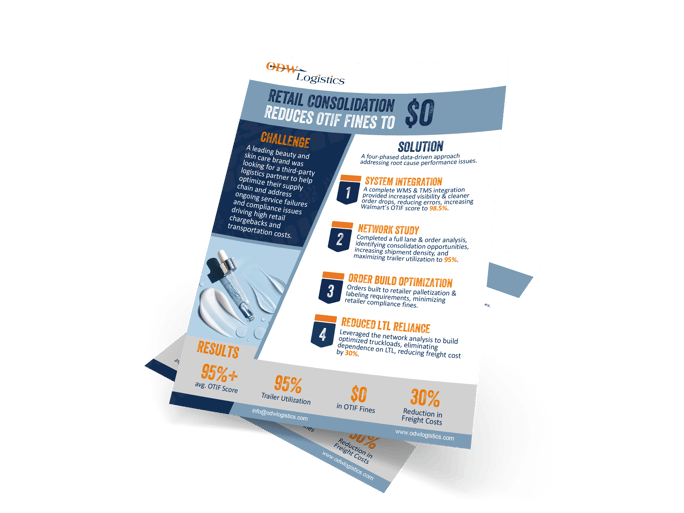
Challenge
A leading beauty and skin care brand was looking for a third-party logistics partner to help optimize their supply chain and address ongoing service failures and compliance issues driving high retail chargebacks and transportation costs.
Solution
A four-phased data-driven approach addressing root cause performance issues.
1. System Integration
A complete WMS & TMS integration provided increased visibility and cleaner order drops, reducing errors and increasing Walmart's OTIF score to 98.5%.
2. Network Study
Completed a full lane and order analysis, identifying consolidation opportunities, increasing shipment density, and maximizing trailer utilization to 95%.
3. Order Build Optimization
Orders built to retailer palletization and labeling requirements, minimizing retailer compliance fines.
4. Reduced LTL Reliance
Used the network analysis to build optimized truckloads, eliminating dependence on LTL and reducing freight costs by 30%.
Results
- 95%+ Avg. OTIF Score
- 95% Trailer Utilization
- $0 in OTIF Fines
- 30% Reduction in Freight Costs
Related article: Retail Consolidation: Compliance, Strategy & KPIs
How to Choose Between Retail Consolidation and LTL
The right model depends on your freight and your scorecards. Four questions usually settle it, and answering them before you ask for a quote ties the comparison to your own lanes instead of an industry average.
How much do you ship to each retailer? Steady weekly volume to the same distribution centers favors consolidation, while sporadic shipments may still suit LTL.
What does your scorecard show? Check whether misses are late arrivals, short cases, or labeling errors. Each one points to a different fix.
Who owns the appointment? Ask whether your provider confirms delivery appointments before orders are released or schedules them after the freight is already built.
Can you see exceptions early? Ask what visibility you get between pickup and delivery, and who acts when a delay appears.
For a broader look at retailer requirements, see ODW's retail compliance guide for CPG brands. If you are also weighing transportation models, ODW explains how retail consolidation and managed transportation work together.
Frequently Asked Questions
How does retail consolidation improve OTIF performance compared to LTL?
Retail consolidation combines orders headed to the same retailer into fuller trailers that move under one delivery appointment, so fewer shipments have to arrive on time and complete. LTL sends each order through separate handoffs and windows, which adds chances to miss. ODW's retail consolidation program confirms the delivery appointment before releasing the order to the warehouse.
How does consolidating LTL shipments impact OTIF scores with major retailers?
Consolidating LTL shipments usually improves OTIF scores by cutting the number of shipments a retailer scores, which reduces exposure to missed windows and short cases. The gains are largest with steady volume to the same retailers. In ODW's beauty brand case, OTIF averaged 95 percent or better and OTIF fines fell to $0.
What does OTIF stand for, and how is it measured?
OTIF stands for on-time, in-full. Retailers check whether an order arrived inside its delivery window and whether the full quantity of ordered cases arrived. Each measure has a target, and suppliers that fall below either one can be charged a fine. Targets and penalty terms vary by retailer, so confirm them in each routing guide.
Does retail consolidation eliminate OTIF fines?
No model guarantees zero fines. Consolidation reduces transportation risk by cutting handoffs and tightening appointments, but misses that start with order data, inventory, or labeling still need to be fixed. In ODW's beauty brand case, fines reached $0 after system integration, a network study, order build changes, and less LTL reliance worked together.
When should a CPG supplier switch from LTL to retail consolidation?
A switch tends to make sense when a supplier ships steady weekly volume to the same retailers, sees recurring OTIF misses or chargebacks, and pays LTL rates on freight that could fill pooled trailers. A lane and order analysis is the usual first step, and ODW can run one before you commit to a change.
Getting Retail Consolidation OTIF Performance You Can Measure
The gap between the two models is how many shipments a retailer scores and how much control sits behind each one. If your scorecards show recurring misses or your LTL spend keeps climbing, a lane and order review shows where consolidation would help and where it would not.
Ready to compare your own numbers? Contact ODW Logistics to talk through your retail lanes, or request a quote.